

By Gilson Guilherme Miguel Ângelo
Summary
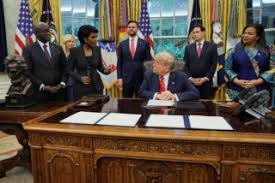
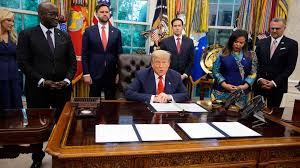
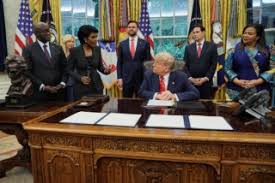
Recent political history has put Donald Trump under multiple spotlights, but rarely under the fair lens of strategic analysis. Often viewed as controversial or unpredictable, Trump has actually demonstrated a pragmatic, commerce-driven vision that has helped avert the escalation into a potential Third World War. His approach—quiet yet effective—represents an effort to replace direct confrontation with diplomacy rooted in productive interests. According to Angolan thinker Gilson Guilherme Miguel Ângelo, Trump’s moves regarding the Ukraine war, negotiations in the Congo, and trade deals with Global South nations clearly aim to build a new world order focused on productive capitalism, strategic peace, and commercial stability.
1. The Ukraine War and the Collapse of the Democratic Agenda
The war between Russia and Ukraine is not merely territorial—it’s a geoeconomic struggle for Ukraine’s strategic resources: rare earths, gas, and fertile land. The insistence of U.S. Democrats, led by President Joe Biden, on bringing Ukraine into NATO was viewed by Moscow as an existential threat. That led to the Russian invasion and a seemingly unending conflict.
According to Ângelo, the Democratic agenda mortgaged the U.S. into a war with no exit strategy. It strained financial resources, drained popular support, and weakened the country’s diplomatic sovereignty. In contrast, Donald Trump—the Republican representative—aimed to avoid this conflict from the start of his previous term. He suspended military aid to Kyiv, promoted discreet negotiations, and advocated for Ukraine’s neutrality. Trump saw what many missed: defending Ukraine’s rare earth resources against Russia and its allies (China, Iran, North Korea) was too costly a battle—and likely unwinnable.
2. The Silent Solution: Congo as a Strategic Trump Card
While the world fixated on Europe’s battlefields, Trump focused on Africa—specifically the Democratic Republic of Congo (DRC), home to some of the largest global deposits of cobalt, lithium, and coltan. These minerals are essential for batteries, semiconductors, and green technologies powering the digital future.
Strategically, Trump saw the Congo—not Ukraine—as the real key to winning the tech and energy race with China. Quietly, the U.S. began influencing diplomatic negotiations in the Great Lakes region, mediated by Angolan President João Lourenço, aiming to secure American interests in rare earths from Central Africa independent of Ukraine. Trump acted like a sharp trader: when one resource (Ukraine) becomes too costly and unstable, find another supplier (Congo). The war between Rwanda and the DRC—centered on ethnicity and mineral wealth—became a stage for U.S. strategic involvement. Peace in the region was not just humanitarian; it was essential geopolitically.
3. Zelensky and the Language He Failed to Understand
Ukrainian President Volodymyr Zelensky, insisting on absolute resistance and ongoing militarization, missed a historic opportunity to reach a peace deal while he still held diplomatic and political capital. By withholding further military aid, Trump sent a clear message: the war is unsustainable, and trade is the future.
Surrounded by foreign advisors and interests, Zelensky failed to read that message. Now, with the U.S. Capitol signaling the end of American military support, Ukraine edges toward collapse—without peace, without reconstruction, and with its sovereignty deeply compromised.
4. The Art of Negotiation and the New Trade Order
Trump extended his vision to India, Vietnam, Pakistan, and other Global South nations. He struck or proposed bilateral agreements aimed at:
- Building new semiconductor supply chains;
- Providing alternatives to Chinese manufacturing;
- Expanding U.S. productive influence without military entanglements.
For Trump, the future belongs to those who produce with allies, not bomb with ideology. This closely aligns with the GAESEMA philosophy—that sovereignty arises from production, not destruction.
5. Angola: The Commercial Link and the Silent Route to Peace
In this new strategic paradigm, Trump is now turning his eyes to Angola, which has emerged as the true logistical and diplomatic axis of Africa’s new productive order. Interestingly, Democrats already recognized this: President Joe Biden’s historic visit to Angola near the end of his mandate reinforced U.S. support for a railway connecting the DRC to Angola’s Lobito Port.
This U.S.-funded project allows Congo’s rare earths to be exported via Angola to the Lobito Atlantic gateway, and onward to Europe and America. It’s a silent trade highway whose rails conceal the true solution for the Ukraine crisis and the West’s quest for productive independence.
Angolan thinker Gilson Guilherme Miguel Ângelo sees Angola playing a prestigious role: mediator, transit territory, and future producer. The country not only facilitates peace between the DRC and Rwanda but also holds its own strategic reserves of the very rare earths contested in Ukraine and the Congo.
Trump knows this. His Republican agenda in Africa will feature Angolan leadership, especially from Luanda—where peace accords are born and a new export route for tech capitalism is legitimized. Trump’s presence in Africa will come not with troops but with signatures and logistics deals, demonstrating that strength lies in productive organization—not military force.
6. Gilson Guilherme Miguel Ângelo’s Perspective
To the Angolan thinker, Trump represents a quiet civilizational and strategic shift. While not usually framed as a political philosopher alongside Xi Jinping, Angela Merkel, Queen Elizabeth, or Vladimir Putin, Trump adheres to a productive, commercial, and diplomatic logic that avoids war and reinforces value chains.
His relationship with Putin, strategic neutrality in unwinnable conflicts, and efforts outside Europe’s theater reveal that Trump views the world as a vast marketplace—not a battlefield.
Ângelo believes Africa should watch closely. Nations like the Congo, Angola, Zambia, and Namibia—with their oil, uranium, diamonds, and rare earths—must:
- Negotiate with sovereignty,
- Demand respect for their productive culture,
- Avoid becoming mere extraction sites without local benefit.
7. Trump, Global Balance, and Angola’s New Era
In today’s geopolitical context, Donald Trump is more necessary than ever. His friendship with Putin and refusal to confront Russia head-on are truly containment strategies—not submission. Trump understands the era of open superpower wars is over; what follows is a war for commercial, technological, and productive influence. He is a strategist preparing for silent battles of production, markets, and innovation.
By avoiding direct confrontation, Trump allows Russia and China to solidify their spheres of influence: Russia in Eastern Europe, China across Asia and critical value chains. But this is not U.S. weakness—it’s a global order being rebalanced. Instead of territorial dominance, Trump anticipates a quiet war fought with trade and tech.
According to Ângelo, this proves the revolution of the future will be productive—not military. Whoever meets the world’s greatest needs—energy, food, rare metals, water, technology—will win without firing a shot. Trump is building new trade routes, reviving American manufacturing, and forging economic alliances in the Global South. He knows that production, not domination, will win the 21st century.
With U.S. military aid to Ukraine halted, Putin sees geostrategic victory near. Paradoxically, this opens a window for Zelensky to pivot from militarism toward productive peace—exactly what Trump has advocated.
This is where Africa—and especially Angola—becomes pivotal. The new world order emerges not from bombs, but from resource flow and infrastructure. Angola is at its core.
Angola offers:
- A land rich in rare earths, oil, gas, and biodiversity;
- Resilient people, shaped by history of struggle, sovereignty, and reconstruction;
- Strategic geographic position linking Central Africa to the Atlantic;
- Active, respected diplomacy led by João Lourenço across the continent.
Trump must truly engage with Angola—its spiritually grounded people, ideological resilience, and historical parallels with post-colonial America. Angola, in turn, must understand Trump—a direct, pragmatic, outcome-focused leader who respects sovereign, productive nations.
Thus begins a new era for Angola: the era of dealing with Trump. Not as a subordinate, but as a strategic partner in building a new productive world. Angola must position itself with wisdom, determination, and vision—embracing its productive and diplomatic vocation to become more than a logistic corridor, but a sovereign and influential player in global economic diplomacy.
In this cycle, Trump embodies order, practical production, direct trade, and strategic peace. Angola offers fertile soil, resilient soul, and mediating intelligence for an Africa that wants to produce, negotiate, and succeed—with justice and sovereignty.
Conclusion: The New Capitalism is Quiet, Strategic, and Commercial
Donald Trump—often misunderstood—has emerged as a commercial visionary who prefers agreements over war, substantive results over political noise, and production over populist ideologies.
If the world follows this path—as GAESEMA philosophy suggests—the new global order may be born from production, trade, and genuine peace. The 21st century will not be won by force, but by those who negotiate with the right resources, at the right time, and with the right partners.
In this equation, Trump, Angola, and the Congo–Lobito corridor have already begun to write a new chapter in history.
The GAESEMA Journal can be accessed via the official website:
👉 www.revistagaesema.com
Publisher: Gaesema
Email: gaesefma@gmail.com
WhatsApp: +244 923 486 495
(These are the official channels where you can submit articles for publication and follow the released editions.)
Article Published by the GAESEMA Journal
G
Descubra mais sobre Revista G
Assine para receber nossas notícias mais recentes por e-mail.
